
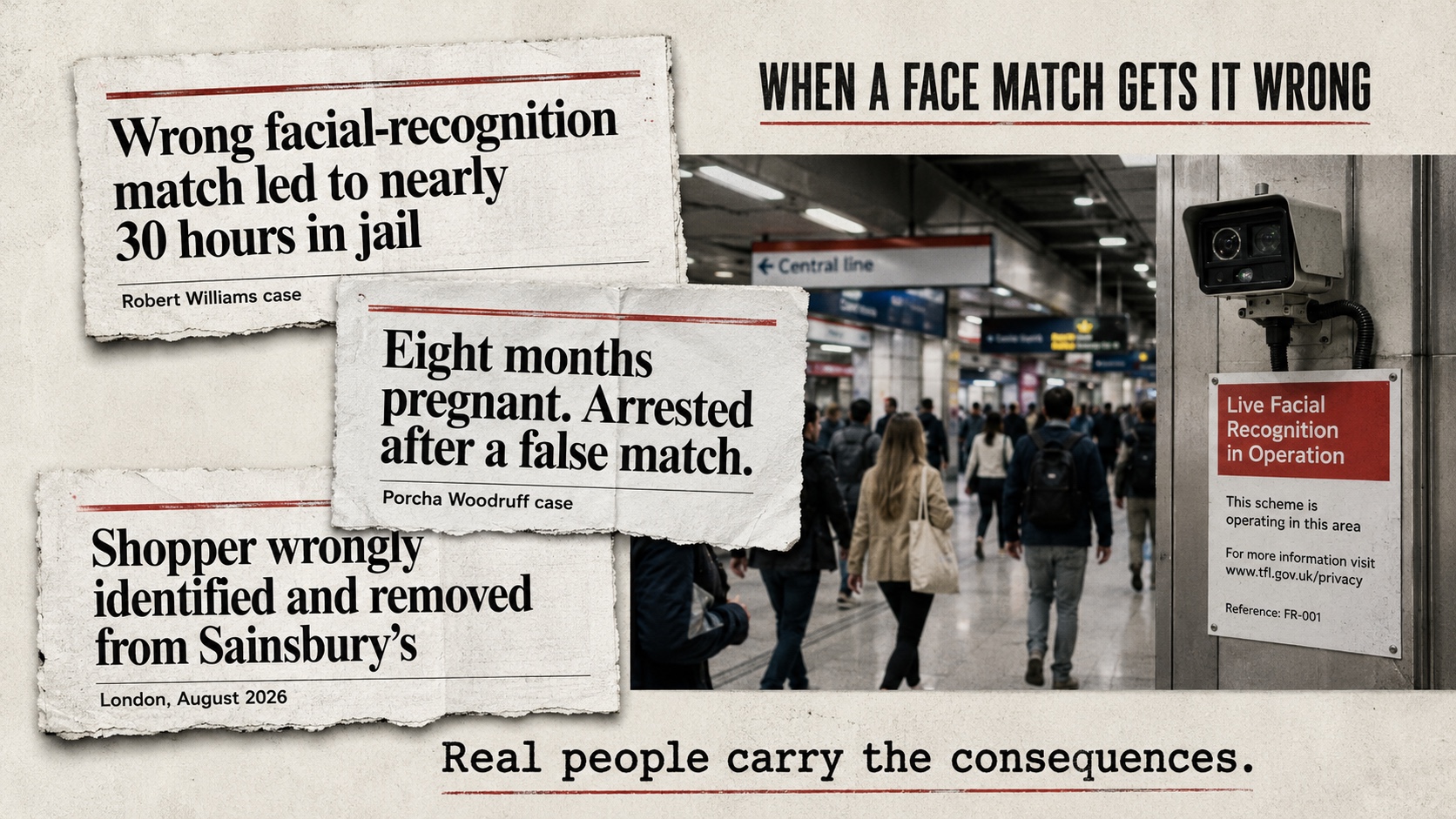
A face match is an investigative lead, not proof
A typical system extracts features from a probe image—perhaps a security-camera frame—and compares them with faces in a database. It returns candidates that cross a configured similarity threshold. The result can be useful, but it is not the same as a verified identification. Detroit's current police guidance explicitly treats a facial-recognition result as an investigative lead that requires independent investigation.
Accuracy is not one universal number. NIST's Face Recognition Technology Evaluation explains that false-positive and false-negative rates vary by algorithm and demographic group, while camera quality and operating conditions also matter. That is why a vendor's headline accuracy figure cannot describe every real deployment or decision.
The important distinction
An algorithm can suggest the wrong person, but harm often emerges from the whole workflow: which image is submitted, which database is searched, how a reviewer interprets the result, whether contradictory evidence is pursued and whether the affected person can appeal.
Three incidents that show different failure modes
These cases should not be collapsed into one claim. Two involved reported false facial-recognition matches in policing; the retail case involved an alert and a staff decision that the companies later attributed to human error.
What happened
- Robert Williams: Detroit police arrested Williams in January 2020 after a face-search result connected grainy surveillance footage to an expired driver's-license photo. He spent about 30 hours in detention. The Innocence Project describes it as the first documented wrongful arrest caused by facial recognition.
- Porcha Woodruff: Woodruff was eight months pregnant when Detroit police arrested her in February 2023 after a facial-recognition search helped place her older mugshot in a photo lineup. The Independent reported that the charges were later dropped and that she sued the city.
- Sainsbury's in East Dulwich: shopper Matt Arnold said he was refused service and asked to leave after staff associated him with an earlier incident. The Guardian reported that Sainsbury's apologized and paused the store's Facewatch use while investigating.
- The retail nuance: Sainsbury's and Facewatch said the alert itself was correct and that staff made the mistaken identification afterward. Even on that account, the event shows why human review, training, escalation rules and accessible correction processes are part of a facial-recognition system's safety—not separate from it.
What these cases do—and do not—prove
They do not establish that every facial-recognition product performs the same way or that every alert is wrong. They do show that a low-frequency error or a mishandled alert can carry a very high human cost, especially when an organization acts before checking independent evidence.
Where the facial-recognition chain can break
A face-search outcome passes through several technical and human stages. Safety depends on each one, not just the matching model.
Common points of failure
- Probe image: a blurry, angled or partially obscured face may contain too little reliable detail.
- Database and threshold: a larger or poorly governed watchlist creates more opportunities for an unrelated person to score as a candidate; threshold choices trade false positives against missed matches.
- Human review: knowing that software produced a candidate can anchor a reviewer on that person, even when age, body, location or other facts conflict.
- Downstream action: a candidate can influence a lineup, store alert, interview or arrest unless policy requires corroboration and records every decision.
Why 'human in the loop' is not enough
A reviewer needs training, authority to reject the system, access to the original images and a checklist for contradictory evidence. A person who merely approves an alert can make automation bias worse instead of adding meaningful oversight.
From image to consequence: the safeguards that matter
| Stage | Risk | Stronger safeguard |
|---|---|---|
| Image intake | Poor lighting, angle or resolution | Minimum quality rules and rejection of unsuitable images |
| Candidate search | Threshold or watchlist produces a weak match | Validated thresholds, limited databases and documented purpose |
| Human review | Confirmation bias or mistaken interpretation | Trained reviewers, comparison criteria and independent checks |
| Decision and appeal | Alert becomes removal, questioning or arrest | Corroboration, audit logs, notice and a prompt challenge route |
What to do if a face system appears to identify you
Your safest next step depends on the setting. These are practical documentation and privacy steps, not legal advice.
If store or venue staff challenge you
Stay calm and ask for a manager, the reason for the decision and whether facial recognition or a staff observation was involved. Note the time, location and what was said. If it is safe and lawful, keep receipts or other records that help establish what happened. Do not obstruct staff or record bystanders carelessly.
If police question or arrest you
Do not try to litigate the technology at the scene. Follow local legal guidance, ask for legal assistance and preserve documents relating to the identification. A lawyer or civil-rights organization can advise on obtaining records and challenging the evidence in your jurisdiction.
If you want to correct or access a retail record
Find the organization's privacy notice and identify the data controller and any technology provider. Depending on local law and applicable exceptions, you may be able to request access, correction, restriction or deletion. In the UK, unresolved data-protection concerns can be raised with the Information Commissioner's Office after contacting the organization.
If you manage a system that uses facial recognition
Treat every result as a lead, document the purpose and retention period, validate performance under real operating conditions, test for demographic differences, require independent corroboration before adverse action and provide a clear appeal route that a customer can actually use.
Privacy is also procedural
Encryption and device settings matter, but this problem cannot be solved by personal technology alone. Limits on collection, accountable human decisions, record access and correction rights are what keep an uncertain match from becoming an unquestionable fact.
A four-step response checklist
- Clarify the claim. Ask whether the decision came from an automated match, a human observation or both, without escalating the encounter.
- Preserve context. Write down the time, place, people involved and exact explanation; keep relevant receipts, messages and correspondence.
- Use the formal channel. Send a concise written complaint or data request to the organization and ask it to preserve the records connected with the event.
- Escalate when necessary. Seek qualified legal help after detention or serious harm, or contact the relevant privacy or civil-rights regulator when an organization does not resolve a data concern.
A VPN can still reduce exposure on public Wi-Fi by encrypting supported traffic and changing the public IP address websites see. It cannot hide your face from a store or street camera, remove you from a watchlist or correct an institutional record. Use it for the network-privacy problem it actually solves.
Facial recognition FAQ
Can facial recognition identify the wrong person?
Yes. A false positive occurs when the system incorrectly associates images of two different people. The rate depends on the algorithm, threshold, image quality, database and operating conditions, and a human reviewer can either catch or compound the error.
Was the Sainsbury's incident an algorithmic false match?
That has not been established. Sainsbury's and Facewatch said the system sent a correct alert but store staff mistakenly identified the shopper. The incident still demonstrates that training and human decision rules are essential parts of a safe facial-recognition deployment.
Does a VPN stop facial recognition cameras?
No. A VPN protects supported internet traffic and changes the public IP address seen by online services. It does not conceal your physical face from cameras or control how an organization stores and compares facial images.
What should organizations do before acting on a face match?
They should verify image quality, use trained reviewers, seek independent corroborating evidence, document the decision and provide notice plus a prompt way for the affected person to challenge or correct the record.
Questions worth asking next
The right questions expose whether an organization has built real safeguards around the matching tool.
Related privacy guides

Protect the traffic your device sends
Facial recognition needs policy and accountability. For the separate risk of exposed network traffic on public Wi-Fi, Free VPN US provides a simple encrypted connection on iPhone and Mac.
- Encrypted supported traffic
- Public IP privacy
- iPhone and Mac apps