
What Meta's smart-camera patent actually describes
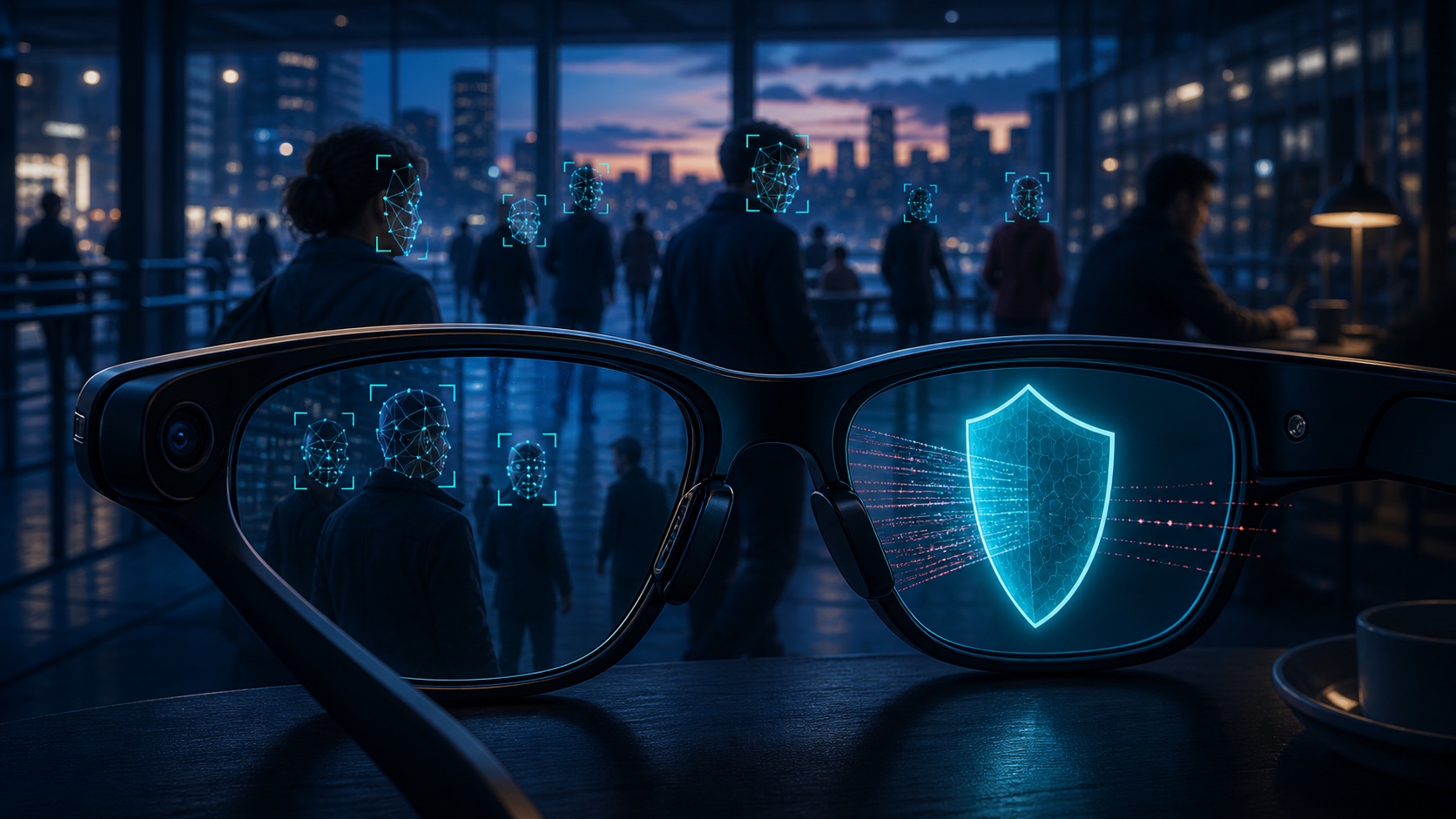
The CNET report points to a patent filing for an assistant-enabled camera system. The underlying public patent record describes detecting people in a camera's field of view, assigning identifiers with facial-recognition algorithms, analyzing facial expressions and using eye gaze, scene understanding and relationship data to choose a point of interest.
One example places the wearer at a dinner party. The system recognizes the wearer's wife, centers her in the frame, notices other guests laughing and generates personalized highlight files. It also describes querying episodic memories—such as asking whether the wearer previously met a person in a red shirt—and retrieving older posts, comments, images or clips connected with that encounter.
Read patents as possibilities, not promises
A patent can protect an idea without becoming a product. It does not establish a launch date, final design, default setting or data policy. The filing is still relevant because it reveals the types of inputs and decisions Meta has considered combining in wearable cameras.
Similar cases show the pieces already exist
The full patented experience is not available to consumers, but several documented cases demonstrate that camera glasses, facial search and personal-data aggregation can already be connected.
Four important precedents
- I-XRAY demonstration: In 2024, Harvard students AnhPhu Nguyen and Caine Ardayfio combined Ray-Ban Meta glasses, PimEyes and people-search services. Their proof of concept could connect a captured face with names, addresses and phone numbers in under a minute. They did not release it publicly.
- Meta's unreleased NameTag work: WIRED reported in June 2026 that dormant face-recognition code and a Rank One Computing integration had appeared in test versions of Meta's companion app. The systems were never active for users, and Meta removed the code after the reporting.
- Facebook's earlier face templates: In 2021, Meta shut down Facebook's broad face-recognition system and said it would delete more than one billion individual templates, citing societal concerns and unclear regulation while preserving narrower identity-verification uses.
- The Google Glass precedent: Google told privacy regulators in 2013 that it would not approve facial-recognition Glassware without strong protections. Its policy also required the display to remain active during camera use—an early recognition that wearables make notice and consent unusually difficult.
None of these proves current Meta glasses identify strangers
I-XRAY used third-party services rather than a built-in Meta identification feature. NameTag was a dormant internal prototype. Facebook's former photo-tagging system was a different product context. Together, they show technical feasibility and recurring governance problems—not a secret feature that every current wearer can activate.
Why wearable facial recognition changes the privacy equation
A phone camera is visible when someone raises it. Smart glasses can look ordinary and remain pointed wherever the wearer looks. Adding identification or behavioral analysis changes a fleeting encounter into structured, searchable data.
The main privacy risks
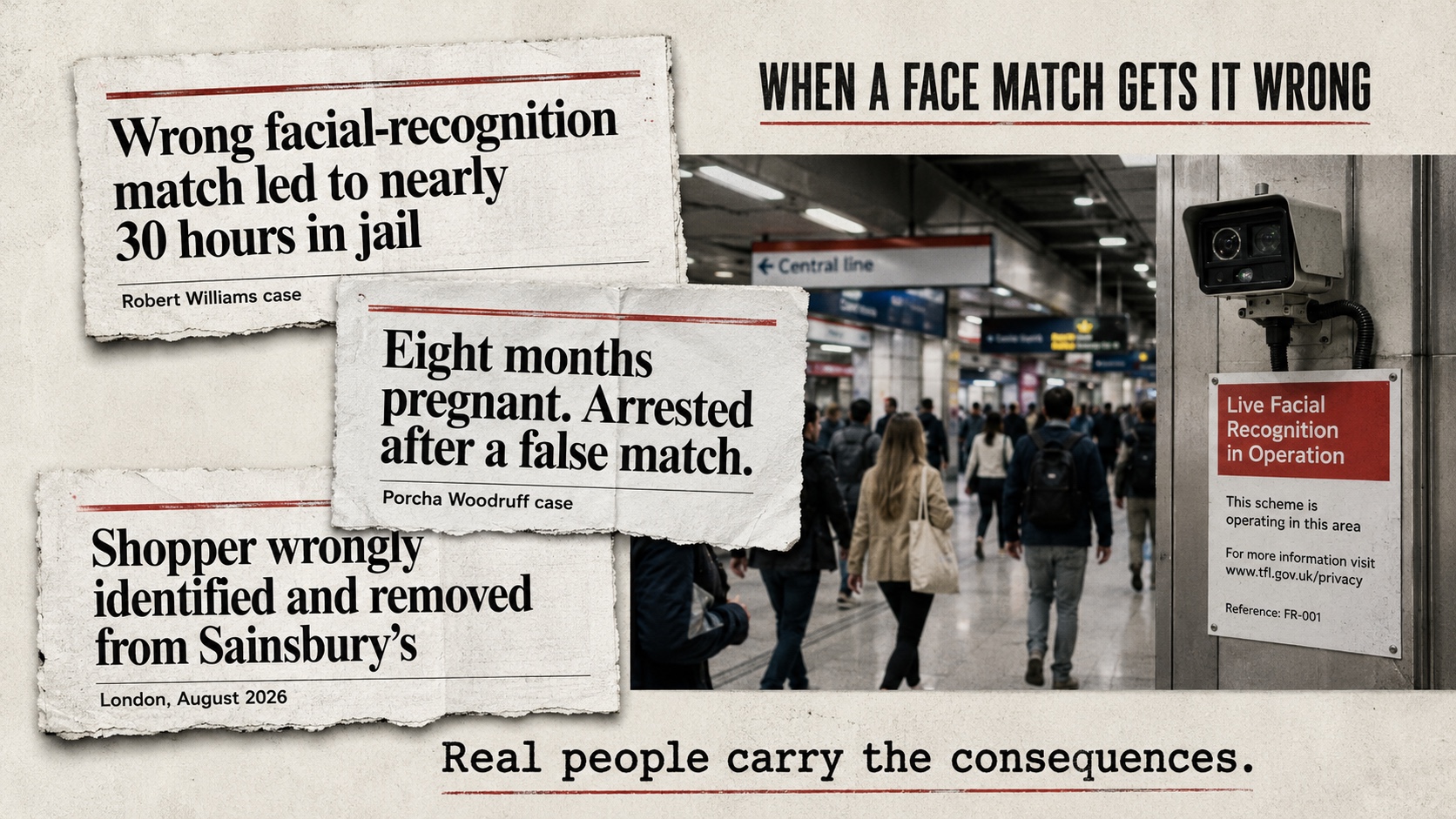
- Bystander consent: people in a café, clinic, school or private home may not know their faces are being analyzed, even if no final video is saved.
- Identity enrichment: a face match can be linked with social profiles, public records, addresses, workplaces or relationship graphs, lowering the effort required for stalking or doxxing.
- Invisible inference: expression analysis can label a person as happy, angry or interesting without their knowledge, although facial movement is not a reliable window into a person's full emotional state.
- Persistent memory: episodic search can convert meetings, locations and relationships into a long-term encounter history whose retention and access rules may be unclear.
A recording light answers only one question
Meta says the capture LED on current glasses signals when the camera is being used. That is useful notice for recording, but a future system would also need to disclose when faces are analyzed, matched or used to personalize results. A bystander should not have to guess whether a light represents a saved photo, temporary processing or biometric identification.
Capability versus privacy safeguard
| Capability | Bystander risk | Minimum safeguard |
|---|---|---|
| Face identification | A stranger is linked to a real identity | Default off, explicit consent and no public-profile lookup |
| Expression analysis | Behavior is inferred without context | No high-stakes use; clear notice and local processing |
| Automatic capture | Private moments are recorded unexpectedly | Unmissable indicator, manual confirmation and sensitive-place blocks |
| Searchable memories | Encounters become a persistent history | Short retention, user review, deletion and access logs |
What people can do today
No personal setting can solve bystander surveillance, but a few steps can reduce exposure and set healthier norms.
If you wear camera glasses
Tell people before recording, ask permission in private settings, keep the capture indicator functional and avoid bathrooms, clinics, schools, confidential workplaces and other sensitive spaces. Do not connect the camera feed to third-party face-search or people-search tools.
If someone else's glasses make you uncomfortable
Ask calmly whether the device is recording and request that the wearer stop or exclude you. Move out of frame when practical and involve venue staff rather than confronting the wearer. Rules vary by place, so do not assume every public recording is unlawful.
Reduce what a face match can reveal
Review which social profiles and photos are public, remove unnecessary phone numbers and addresses from open pages, use data-broker opt-out processes and ask friends not to tag or name you publicly without permission. This cannot prevent capture, but it can reduce the dossier attached to a match.
If you run a venue or workplace
Publish a clear camera-wearable policy, identify sensitive areas, train staff to apply it consistently and offer a private alternative for visitors who rely on assistive glasses. A blanket response can unintentionally exclude people with disabilities, so focus on recording and identification behavior rather than appearance alone.
The bystander needs controls too
Most device settings belong to the wearer, but the person being scanned carries much of the privacy risk. A credible system needs notice, consent and deletion mechanisms that work for non-users who may never have a Meta account.
Questions Meta—and every smart-glasses maker—should answer
- Whose faces can be matched? Define whether matching is limited to consenting contacts, user-supplied libraries, company profiles or open-web images.
- Where does processing happen? Explain which face templates stay on-device, which reach cloud systems and whether any data trains models.
- How will bystanders know? Use an unmistakable signal for biometric analysis, not only for saved photos or videos, and make tampering difficult.
- How can a non-user object? Provide a practical way to request access, deletion or exclusion without requiring the person to create an account.
A VPN protects supported network traffic and changes the public IP address online services see. It cannot hide your face from smart glasses, prevent local biometric processing or remove personal details from a face-search result. Use a VPN for network privacy, and use data minimization, consent rules and platform accountability for wearable-camera risks.
Meta smart-glasses facial recognition FAQ
Do current Meta smart glasses identify strangers by face?
There is no confirmed consumer feature that lets current Meta smart glasses identify strangers. Reported face-recognition systems in Meta's companion app were dormant, unavailable to users and later removed. Third parties have demonstrated similar results by combining the glasses' camera feed with external services.
Does the patent mean Meta will release facial-recognition glasses?
No. A patent documents and protects an invention but does not guarantee a product, release date or final implementation. It does show that Meta has explored combining wearable cameras with facial recognition, expression analysis and personalized memories.
Can the recording light reveal facial recognition?
Not necessarily. A capture light can indicate camera use, but biometric analysis might occur before or without saving a photo. Any future identification feature would need clear notice explaining when analysis and matching occur, not only when media is recorded.
Can a VPN block smart-glasses facial recognition?
No. A VPN encrypts supported internet traffic between your device and the VPN service. It does not obscure your physical face from nearby cameras or control another person's wearable, face-search provider or stored biometric data.
Questions worth asking next
The privacy outcome depends on details a patent alone cannot answer.
Related privacy guides

Protect the traffic your own devices send
Wearable-camera privacy requires consent and accountable product design. For the separate problem of exposed network traffic on public Wi-Fi, Free VPN US provides a simple encrypted connection for iPhone and Mac.
- Encrypted supported traffic
- Public IP privacy
- iPhone and Mac apps