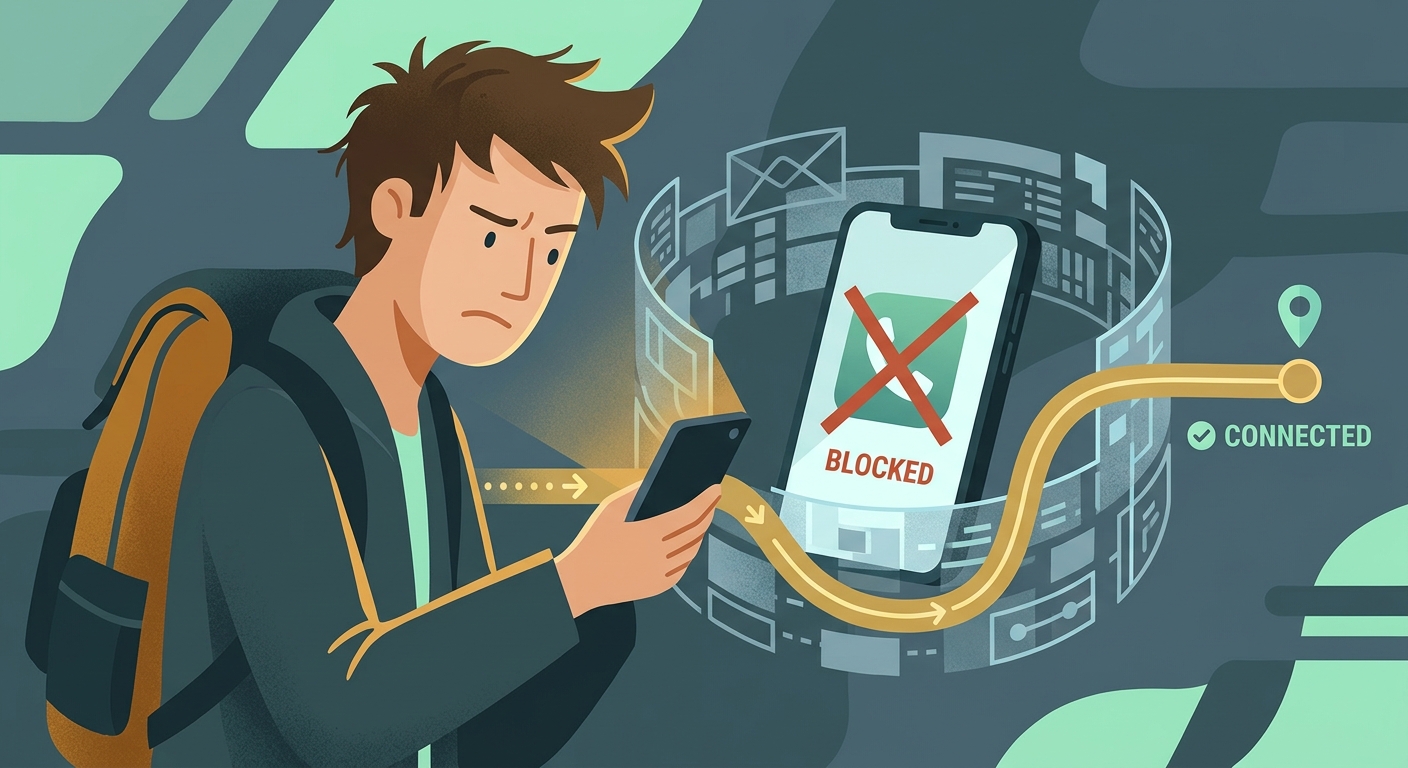
Why It Happens: Economic Monopolies vs. Political Censorship
While the experience of a dropped call is exactly the same, the reasons behind the blocks in the Middle East differ wildly from those in Russia or Iran.
The UAE and Egypt: Protecting Telecom Revenue
In the United Arab Emirates (including Dubai and Abu Dhabi) and Egypt, VoIP restrictions are almost entirely financial. These countries have heavily regulated telecom sectors dominated by state-owned or state-affiliated monopolies like Etisalat and Du. These companies rely on massive revenue from international long-distance calls.
When free, high-quality VoIP apps like WhatsApp and FaceTime became globally popular, they threatened that revenue directly. Why would a massive expat workforce pay per-minute rates to call home when they could use Wi-Fi for free?
To protect these profits, national regulators mandate that internet service providers block the specific data packets used for unauthorized voice and video calls. To make an internet call legally, you are forced to use government-approved, paid VoIP apps (like BOTIM) that often require a monthly subscription fee on top of your data plan. It is a walled garden built to protect a monopoly.
Iran and Russia: Political Censorship and Surveillance
In contrast, the blocks in Iran and Russia are about political control, censorship, and surveillance. Both nations maintain strict control over the flow of information.
WhatsApp and FaceTime use end-to-end encryption, meaning the state cannot easily intercept, monitor, or record calls. Because the government cannot listen in, they simply block the connection entirely at the national firewall level. In times of political unrest, these blocks often tighten, throttling international bandwidth to isolate the population. Here, the block isn't just a hidden tax—it is an active barrier to secure, private communication.
The Toll on Travelers and Expats
The frustration of being cut off from your support system cannot be overstated. For business travelers, the inability to jump on a quick FaceTime sync or WhatsApp call disrupts work, forcing a reliance on expensive hotel landlines or unstable workaround apps.
But for the massive expat communities in places like Dubai, the block takes a deep emotional toll. The UAE relies heavily on expatriate workers from India, Pakistan, the UK, the Philippines, and beyond. Being unable to easily video call your kids, a spouse, or aging parents without paying a premium for state-approved apps feels like an unfair penalty on human connection.
You bought a high-end iPhone. You pay for data. Yet, the basic ability to hear your family's voice is handicapped by the local network. This is why taking control of your own web traffic becomes essential.
Tunneling Past the National Firewall
You cannot change a country's telecom policies, but you can change how your device interacts with its network.
The mechanism blocking your calls works through Deep Packet Inspection and other traffic-filtering methods. When your local internet service provider (ISP) sees data packets formatted for a WhatsApp call, it drops them. To make your call, you need to hide what you are doing. This is exactly what a Virtual Private Network (VPN) does.
A VPN creates a secure, encrypted tunnel between your device and a server located in a different country.
Here is what happens:
- Your iPhone or Mac encrypts your internet request (e.g., "Start a FaceTime call").
- This encrypted data is sent through the local network. The local ISP can see that you are sending data, but they cannot see what the data is.
- The data arrives at the VPN server in an unrestricted region, like London or New York.
- The VPN server decrypts the request and forwards it to WhatsApp or Apple.
- The call connects, and data flows securely back to your phone.
To the local network, it looks like a stream of unreadable data. To WhatsApp and FaceTime, it looks like you are sitting in a coffee shop in London.
Unblocking Calls on iOS and Mac
For most expats and travelers, your iPhone or MacBook is your primary lifeline. While iOS and macOS have excellent built-in security, they natively obey the network restrictions of whatever Wi-Fi or cellular network you join. To bypass these blocks, you need a tool built specifically for mobile masking.
Free VPN US is designed to handle this cleanly on Apple devices, especially for users who just need to get online and make a call without committing to an expensive, long-term subscription.
Why Free VPN US is the Best Tool for This
One of the biggest hurdles is realizing your calls are blocked only after you arrive. At that point, dealing with foreign currency fees and signing up for a yearly VPN plan is a hassle.
Free VPN US solves this instantly through an ad-supported tier. You do not need to pay a subscription or register an account to get your calls working. You simply download the app, watch a short ad to earn premium connection time, and gain immediate access to high-speed, unblocked servers. You trade a minute of your time for an hour-long, crystal-clear FaceTime call with your family.
Choosing the Right Server
For the best call quality, connect to a VPN server that is geographically close to you but outside the blocked zone.
- In the UAE or Egypt: European servers offer the low latency required for voice and video. Open Free VPN US and select UK (London), Germany (Frankfurt), or Netherlands (Amsterdam).
- In Russia or Iran: European servers work well, but depending on local network throttling, you might also have success with US East (New York or Washington) or Asian hubs like Japan (Tokyo).
Step-by-Step: How to Make Your Call
Restoring your access to WhatsApp and FaceTime takes just a couple of minutes:
- Download the App: Download Free VPN US from the App Store on your iPhone or Mac.
- Earn Time: Open the app and use the ad-supported feature to bank premium connection time for free.
- Select a Server: Choose a location where VoIP is legal, like London, Frankfurt, or New York.
- Connect: Tap connect and wait for the VPN icon to appear in your status bar, confirming your traffic is masked.
- Call Home: Open WhatsApp or FaceTime. Your app now believes you are in the unrestricted region you selected. Tap the call button, and your connection will bypass the local firewall.
The Takeaway
Living or traveling in a region that blocks WhatsApp and FaceTime can be incredibly frustrating. Whether it is a government protecting state-owned telecom monopolies or enforcing strict censorship, you don't have to accept the block. By downloading a reliable VPN like Free VPN US and using the ad-supported tier, you can effortlessly bypass the national firewall and restore your ability to make secure, high-quality VoIP calls to your loved ones.
Frequently Asked Questions
More context on VoIP blocks and VPN usage.
Keep Reading
Bypass the National Firewall
Unblock WhatsApp and FaceTime instantly with Free VPN US. Encrypt your connection and talk to your family without expensive telecom fees.
- Unblock VoIP Calls
- Crystal Clear FaceTime
- No Log Privacy